
The glass bead filter is an upgrade to the well-known sand filter.
Due to its biomechanical function and the structure of the filter bed test, it acts as a fine filter, resulting in almost crystal-clear water.
After the formation of a biofilm and the blockage of the capillary, it also has a disintegrating effect.
Depending on the stocking density, a glass bead filter for basins is sufficient up to 600L.
We recommend expanding the number of filters at higher stocking densities or larger basin volumes and installing a redundant system of filters and operating them in parallel.
Alternating flushing intervals guarantee that a filter is always active and thus continuous disinfection is ensured.
Example: Backwash filter 1, continue using filter 2 for another 1.5-2 weeks, then rinse filter 2.
The special feature of our glass bead filter is that the filter screens are equipped with a slot width of 0.8 mm at the top and bottom. This allows the water to lift the filter bed with complete force and flow through it with full volume flow. Thus, the glass beads are swirled through.
The advantage of the filter glass beads is quite obvious; due to their smooth surface, they can be easily cleaned in the rinse flow and can remain in the column.
After rinsing, the filter is ready to use again immediately!
The friction of the beads loosens the dirt from the smooth surface and then flushes the loosened dirt out to the top screen. The column is filled with original filter beads from Sigmund Lindner in size 0.75-1.0 mm. We only use glass beads from Sigmund Lindner because they are of very high quality and chemically inert; there is no change in the chemical parameters (water values) of the aquarium water.
Once the filter is flushed, it can be reinstalled in the filter circuit and operated in the bypass.
The filter should only be used in BYPASS and at a flow rate of 200-300L/h (to develop its optimal effect).
If the glass bead filter is to perform its actual function, it must be operated in BYPASS at 300-400 L/h.
Installation directly in the main stream after the outer filter is not possible!
We also advise against installing this filter as a pure pre-filter in front of a nitrate column, as different volume flows should prevail here. For this purpose we have special pre-filters in the program.
Depending on the stocking density, one glass bead filter is sufficient for tanks up to 600 liters.
For higher stocking densities or larger tank volumes, we recommend increasing the number of filters and installing a redundant system of filters, operating them in parallel.
The filter should be flushed with warm tap water before commissioning.
To do this, connect the filter in reverse (hose from the fitting to OUT and the free outlet IN
the tub), do this for 1-2 minutes!
Ensure that the outlet hose does not kink and that the column is not subjected to excessive pressure!!!
Once the filter has been flushed, it can be installed in the filter circuit and operated in bypass mode.
The filter should only be used in bypass mode and at a flow rate of 200-300 L/h
(to get optimal performance).
We have listed various connection options for you below:
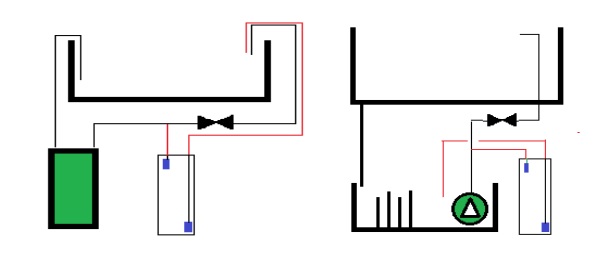
The flow rate for the glass bead filter can be adjusted using the control valve installed in the main flow of the filter.
You can measure the flow rate using a measuring cup (volume of water collected in 10 seconds x 6 x 60 = volume per hour). Keep in mind that as the filter becomes clogged, the flow rate in the bypass decreases, and therefore it must be adjusted and regulated repeatedly.
If air accumulates in the upper part of the column, you can release it through the vent.
The filter should be backwashed and cleaned after 3-4 weeks, as prolonged operation can cause the filter to become contaminated and, due to the large amount of accumulated dirt, turn into a breeding ground for germs.
To backwash the filter, disconnect it from the system and connect it “in reverse” before commissioning, as you would during the flushing process (connect the hose from the faucet to the OUT port and the free outlet to the IN port, leading into the sink or tub).
Shaking the filter column during flushing helps remove dirt. Opening and closing the faucet intermittently also promotes cleaning.
If not all dirt particles are removed during the flushing process, this is not a problem, as they will decompose over time and can then be removed during the next flushing cycle.
The outlet of the column must never be blocked or the hose kinked, and the column must not be pressurized.
After the flushing process, the filter can be reconnected to the bypass in the direction of flow.
Do you have any further questions?
Simply give us a call or send us an email.
 Camino Real, 1975