
This is a method of culturing White Worms that I find way cleaner than the coco coir. Elbert Liu (member of the Facebook group “Live Food cultures for Aquariums”) who has been doing it for a long time suggested it to me and I tried. This is his original post describing culturing White Worms on kitchen scrub pads:
https://www.facebook.com/groups/432322223628325/posts/1829836487210218
This is his video explaining the sponge culture in detail:
https://www.youtube.com/watch?v=Cg6At6Rr2n4
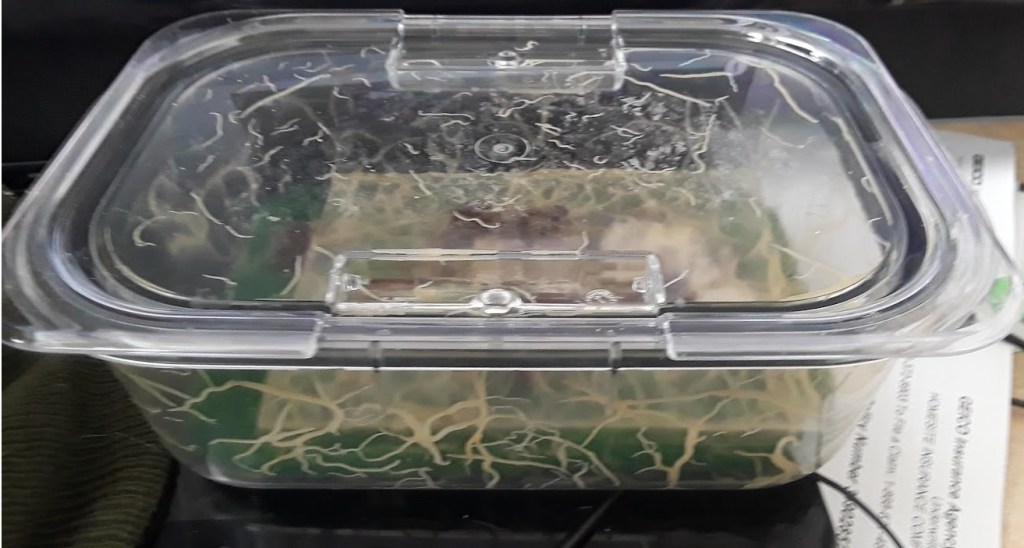
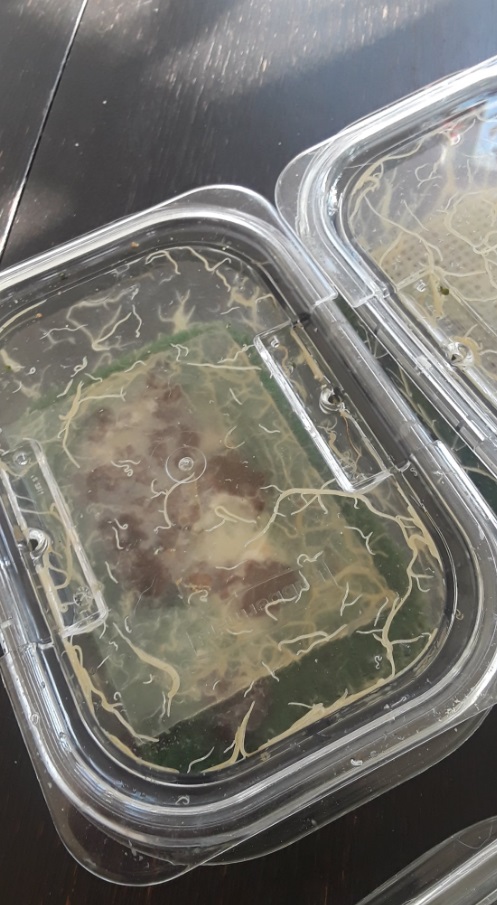
I just transferred some of my existing worms with a little bit of their coco coir into the new boxes that have no soil but sponges only. That was about 4 days ago. This morning I wake up to see what you see on the picture below.
I feed kefir diluted with a little bit of RO water, mixed with white flour, and I sprinkle dry nutritional yeast first, then squirt the kefir, then sprinkle some more yeast. The kefir mixed with the flour is in a condiment bottle so it is easy to store in the fridge, take out and squirt as much as I need on any culture that needs it. Super clean.
What you see on the picture is:
Rubbermaid Brilliance food container. 3.2 cups size.
These containers have a very reliable seal. No worm escapes.
Also they have two plastic latches that are easily removable. When removed the lid ends up with two small holes which were under the latch. Perfect for ventilation. Elbert covers the holes with fabric against insects. I do not because my boxes are in a small fridge set at 63F and no insect problem for many months now.
Plastic craft mesh on the bottom.
Cut to size. Meant to keep the pad that is above away from moisture/water that collects on the bottom.
Scrub pad.
Needs to not be too fine but not too coarse either. Worms get wedged in a super fine pad and you can’t get them out.
Another plastic craft mesh on top of the sponge.
So some of the worms attach to it and are easy to gather and feed to the fish.
– Elbert feeds dry dog food. From previous experience with dry dog food and Grindals (not White Worms) I learned that they can not eat hard food. So I feed my mixture of kefir/flour/nutritional yeast. More details on that mixture are below.
Upkeep is about removing the waste that the worms make. With the pad what Elbert does is to squirt water on the pad after a few feedings, let the water go through the pad and collect on the bottom. Then just dump that water out.
Also once a month or so he rinses the pads under running water. That really cleans the pad. I do not know what happens to the bacteria that is important for the worm’s well being and feeding but he has been doing that for a long time and it works.
I’m sure that method is used by other people. But the fine details are what makes you successful or not and Elbert has being doing this for a long time. This last year I had huge ups and downs with the Ramsey method. Never could predictably manage the worm growth. Either tons or dwindling for no apparent reason. Not to mention the mess and sometimes the stench.
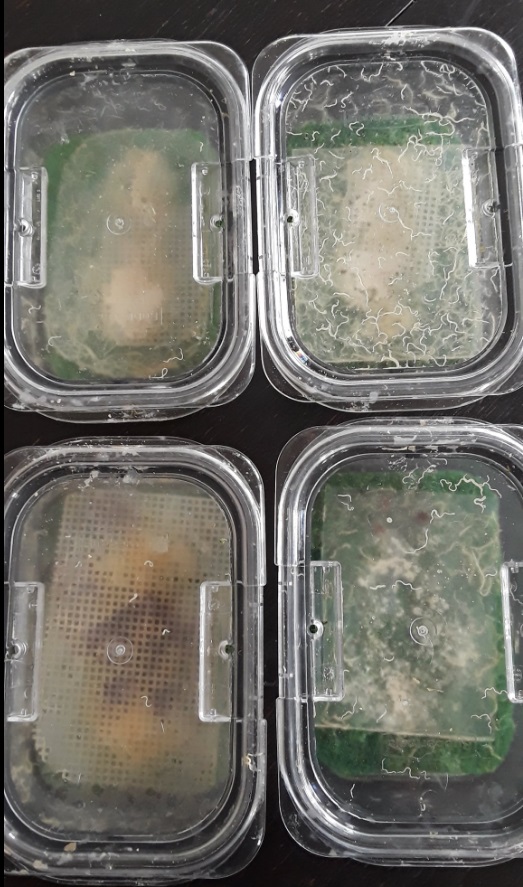
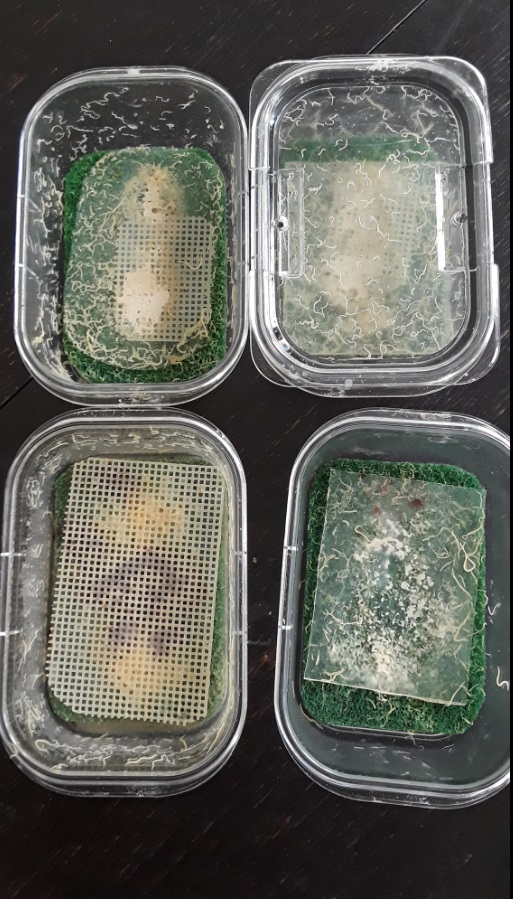
What you see on the pictures below is two two week-old boxes and two two-day-old boxes. All of them were seeded with worms from my existing coco coir boxes that are just about to crash (waste accumulation).
Feeding: I started feeding a mixture of kefir/nutritional yeast/cooked cream of wheat. Everything is blended into a smoothie in a blender. Then poured in a squirt bottle and stored in the fridge. It is super clean and easy to use the squirt bottle when feeding the worms, it is ready to go plus maybe the yeast does its magic a little bit while in the fridge. First sprinkle dry nutritional yeast on the sponge, then squirt the food mixture, and finish with another sprinkle of yeast.
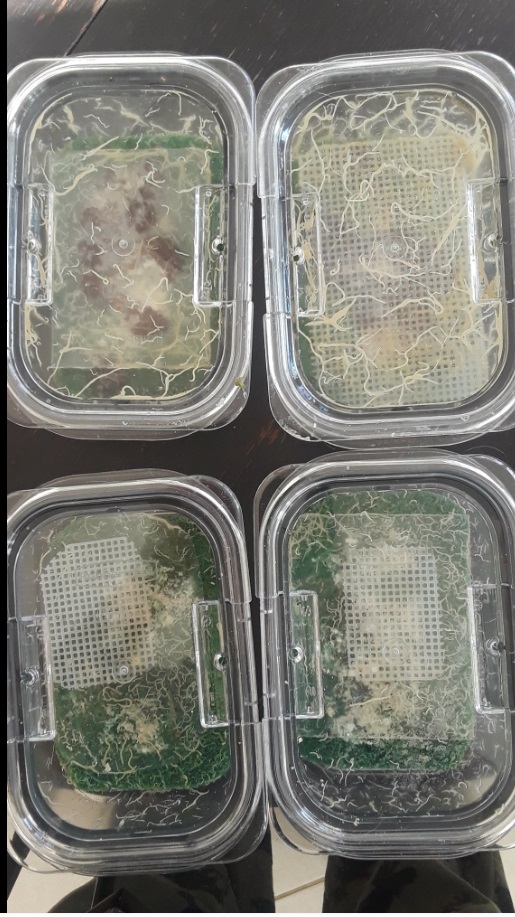
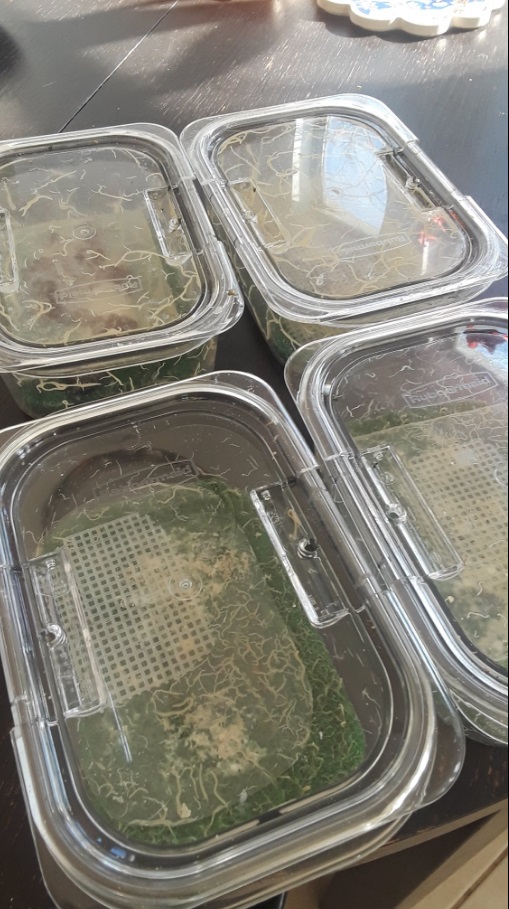
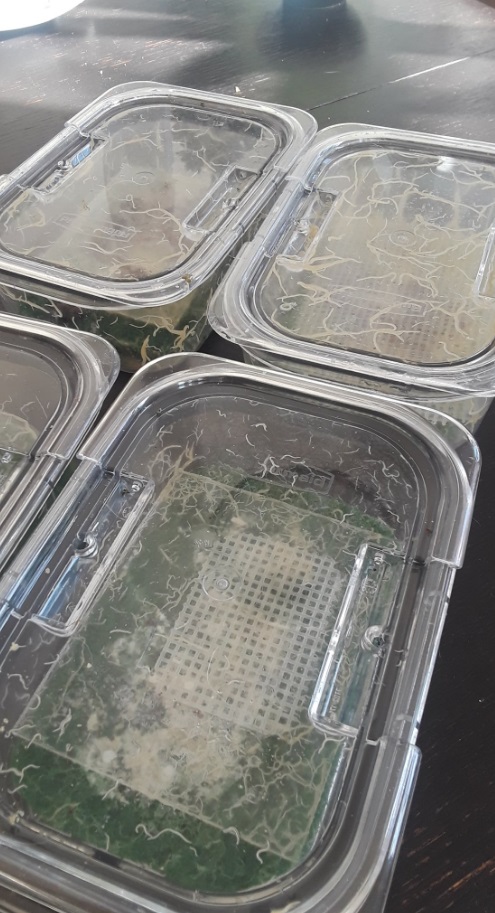
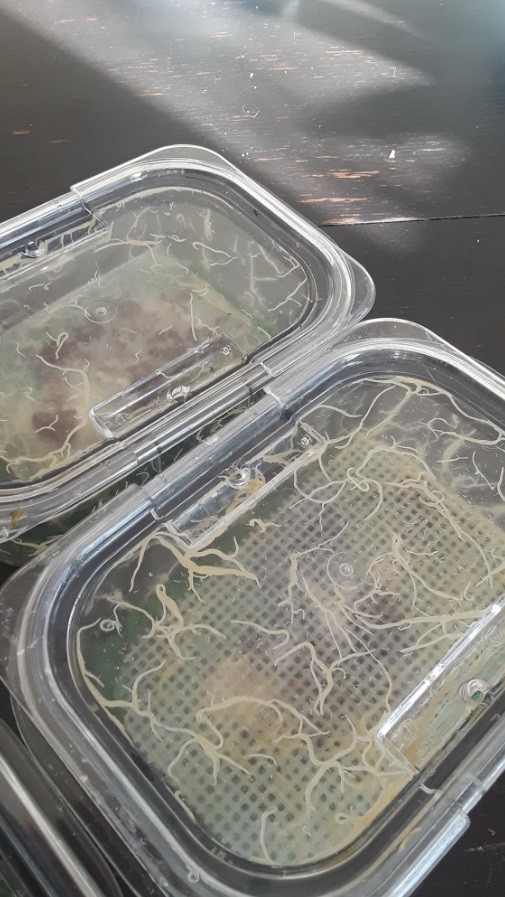
Below are pictures about 14 days after starting the sponge culture.
The two pictures are identical – except that the second picture has 3 of the lids removed so you can see better what is going on in each box. Box 2 is obviously doing great so the lid is left on. No smell.
Box 1 is also doing well but the worms are not on the lid so I opened it and you can see the young worms. No smell.
Box 3 is in need of washing the sponge. That is obvious from the cloudy looks of the box – moisture on walls mixed with slime. Also the box has a lot of liquid under the sponge. You can see it on the second picture – murky liquid just under the sponge (the other 3 boxes do not have that). And the smell is strong and specific. So – those are the signs of the sponge needing to be washed.
Box 4 is a box in which I washed the sponge 24 hours ago. I used aquarium water and just poured it over the sponge, shook the sponge a bit, and drained the water. Did this about 7 times. Each time filling the box about 3/4″. The stench is strong so do not do this at the kitchen sink – better outside. After the sponge washing I took worms from the other boxes and put them over the sponge. Fed my usual liquid kefir/cooked cream of wheat/nutritional yeast mixture + sprinkles of dry yeast before squirting the mixture and after squirting it. You can see the results in box 4 after 24 hours – perfectly healthy starting culture. No smell now.
So far my lessons are:
– I’m running a “high speed” version of Elbert’s method. He uses dry dog food. That is why my cultures grow faster, pollute faster, and the sponge needs to be washed more often. He washes once a month – I apparently will have to wash every 10-12 days.
I need to feed the worms every 2-nd day.
Washing: When washing the sponge you loose some worms, their eggs, and of course any beneficial bacteria that may have a role in all this. Basically you start the culture from zero – more or less. But washing the sponge is easy, you do not throw away a bunch of soil, with the soil method you will loose worms/eggs too with the soil, the soil needs to be pre-soaked, etc. So the sponge method is cleaner.
Downsides: Maybe, I do not know, ignoring the sponges for a week or a month will probably lead to complete worm die off. That does not happen that fast with the soil method. I’ve ignored my boxes for 2 months and the worms return when I start feeding. But I think Elbert told me that with his slower way (dry dog food, no liquid mixture) his culture is more stable and can go on without care way longer.
– Keeping the boxes going involves having different boxes in different development phases. Meaning when some boxes are about to crash you have others that are just now exploding with growth. So when you wash some of the sponges you have plenty of worms from the other boxes to seed them. That kind of management is not too complicated. And all the signs how a box is doing is clearly visible or smelled.
I think one should culture White Worms in both soil and sponges. That way there are always enough backups if most cultures crash.
The main thing really is to commit to check on the cultures every day. That way you get a feel what is happening, you are able to see and catch trends, and not be lost about where the cultures are in their stages.
 Camino Real, 1975